

2026 Arizona Governor's Race Early Field — Hobbs Vulnerable, GOP Primary Wide Open
Hobbs Trails Generic GOP Opponent by 3; No Republican Candidate Yet Dominates Primary
PHOENIX (June 12th, 2025) – Eighteen months before Arizona's 2026 gubernatorial election, a new AZPOP survey from OH Predictive Insights finds Gov. Katie Hobbs trailing a generic Republican opponent 47% to 44% — a significant warning sign for an incumbent who won her first term by less than 1 percentage point. Meanwhile, the Republican primary to determine who will challenge Hobbs remains a blank slate, with no potential GOP candidate currently exceeding 14% name recognition among likely Republican primary voters.
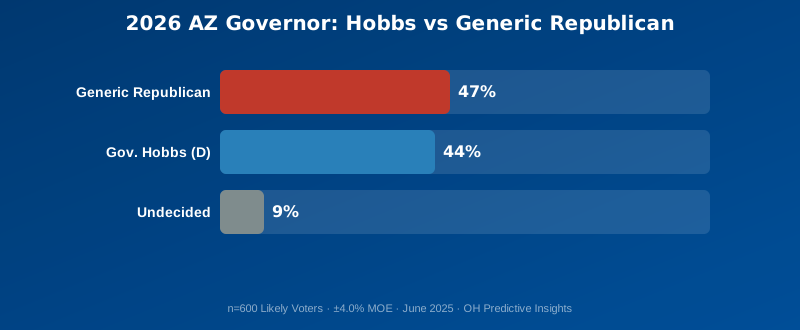
The generic ballot test — which asks voters to choose between Hobbs and a "Republican candidate" without naming a specific opponent — is a powerful measure of an incumbent's structural position at the outset of a campaign cycle. A 3-point deficit against an unnamed opponent suggests that a significant portion of Arizona's electorate is already prepared to vote for change, regardless of who the Republicans nominate.
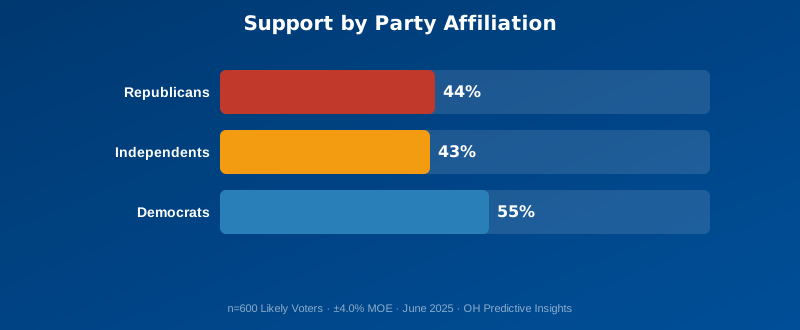
Hobbs' vulnerability stems from three factors measured in this survey: an underwater job approval rating (44% approve / 46% disapprove as of January 2025), weak performance with Independent voters (only 40% approve), and the challenging national environment created by broad voter skepticism about economic conditions.
"When a governor is losing to a generic opponent before a single Republican has announced their candidacy, that's a structural deficit that needs to be addressed," says OHPI Chief of Research Mike Noble. "Hobbs has time to turn this around, but it requires a clear message and a string of accomplishments that change voter perceptions."
Among potential Republican primary candidates tested in the survey, former State House Speaker Ben Toma leads the field with 14% support among likely Republican primary voters, followed by state Senate President Warren Petersen at 11%, Maricopa County Sheriff Jerry Sheridan at 9%, and former congressman David Schweikert at 7%. Fifty-nine percent of Republican primary voters are undecided or have no preference at this early stage.
None of the tested candidates have the name recognition or fundraising profile to quickly consolidate the Republican primary. Notably, Kari Lake — who lost two consecutive statewide races — has not publicly indicated interest in the governor's race, and her name appears in just 4% of Republican primary respondents' preferred candidates.
"The Republican field is genuinely open," says OHPI Data Analyst Jacob Joss. "The right candidate — someone with strong name ID, fundraising ability, and an ability to unite both the Trump base and the more traditional GOP establishment — could consolidate this primary quickly. But that candidate hasn't emerged yet."
Hobbs' path to re-election likely runs through a major economic policy achievement — ideally one connected to water security, job creation, or housing — combined with a divided or weakened Republican field. The survey suggests she has work to do on all fronts.
Methodology: AZPOP conducted June 7–9, 2025. Blended 47% Live Caller / 53% IVR. Arizona Likely Voters (general election question) and Arizona Likely Republican Primary Voters (primary question). n=600 with ±4.0% MOE.
Media Contacts:
Mike Noble, OH Predictive Insights, [email protected], (480) 313-1837
Jacob Joss, OH Predictive Insights, [email protected], (602) 687-3034
Charts & Images
Related Articles

POLL: Hobbs and Toma Locked in Dead Heat — Arizona 2026 Governor Race a Toss-Up
The Arizona 2026 gubernatorial race is a statistical tie, with Gov. Katie Hobbs at 47% and likely GOP nominee Ben Toma a…

POLL: First Head-to-Head — Hobbs Leads Toma 48% to 44% in Early 2026 Governor Poll
The first head-to-head poll of the 2026 Arizona governor's race shows Gov. Katie Hobbs leading likely GOP nominee Ben To…

POLL: Hobbs Approval Slips to 44% in Year Two — Budget Fight Takes Toll
Gov. Katie Hobbs' job approval has slipped to 44% in her second year, down 4 points from January 2024, as a prolonged bu…

POLL: Hobbs Approval Rating at 48% After One Year in Office
Gov. Katie Hobbs posts a modest 48% job approval rating after her first year in office, with strong support from Democra…