

Arizona Voters Narrowly Split on School Voucher Program
48–46 Split Reflects Deep Partisan Divide; Independents Hold the Balance
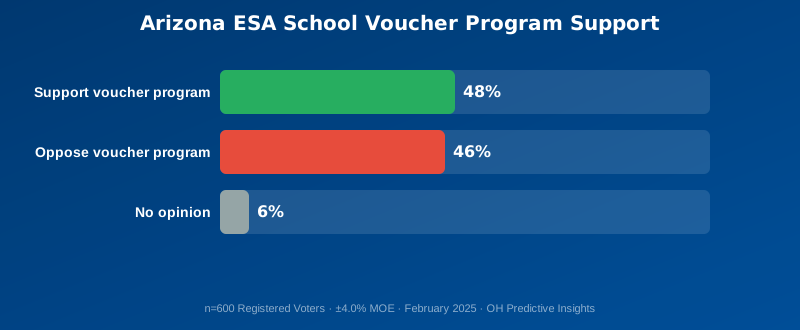
PHOENIX (February 20th, 2025) – Arizona voters are evenly split on the state's universal Empowerment Scholarship Account (ESA) voucher program — which provides state funds to families to pay for private school tuition, homeschooling, and other educational expenses — with 48% supporting the program and 46% opposing it, according to a new AZPOP survey from OH Predictive Insights. Six percent have no opinion.
Arizona became the first state in the nation to implement a universal ESA program in 2022, expanding the voucher program to all K-12 students regardless of income. The program has been both lauded as a national model for school choice by conservatives and criticized as a threat to public school funding by educators and Democrats. The controversy has remained at the forefront of Arizona education policy debates ever since.
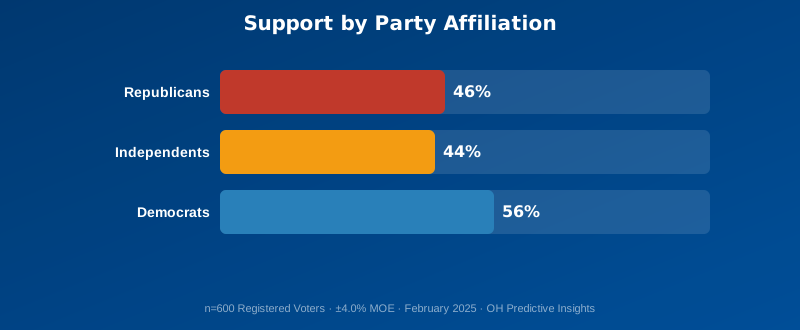
The partisan split is stark: Republicans support the program 78% to 17%, while Democrats oppose it 79% to 17%. Independent voters are closely divided, 50% support to 44% oppose — a slight tilt toward support that mirrors the narrow statewide margin.
"The school voucher debate encapsulates the fundamental ideological divide about public versus private education," says OHPI Chief of Research Mike Noble. "In Arizona, where the program has been in place long enough for people to see real-world results, the debate has become more empirical and less theoretical."
Parents with children currently using ESA vouchers strongly support the program (87%), while parents with children in public schools are more mixed (44% support, 51% oppose). Parents who have considered but not used vouchers are 52% supportive — suggesting that access to the program increases its popularity.
The survey tested several specific concerns about the program. Among opponents, the top concerns are the diversion of funds from public schools (cited by 61% of opponents), the lack of academic accountability for private schools receiving voucher funds (54%), and concerns about religious schools receiving public money (38%).
Supporters cite parental choice as their primary reason for backing the program (cited by 67% of supporters), followed by the ability to customize education for children with special needs (45%) and competition improving school quality (31%).
The survey also tested a modified version of the program: a means-tested voucher available only to families below a certain income threshold. This modified program receives substantially broader support — 63% to 32% — suggesting that much of the opposition to the current universal program stems from concerns about public funds benefiting affluent families who would have chosen private school regardless.
"The income-test modification shifts the political calculus dramatically," says OHPI Data Analyst Jacob Joss. "A targeted program that helps lower-income families access better schools polls like a consensus issue. The universal program's inclusion of wealthy families creates the political vulnerability."
Methodology: AZPOP conducted February 15–17, 2025. Blended 48% Live Caller / 52% IVR. Arizona Registered Voters. n=600 with ±4.0% MOE.
Media Contacts:
Mike Noble, OH Predictive Insights, [email protected], (480) 313-1837
Jacob Joss, OH Predictive Insights, [email protected], (602) 687-3034
Charts & Images
Related Articles

POLL: Arizona Voters Split on Student Debt Relief — Younger Voters Strongly in Favor
Arizona voters are divided on federal student debt cancellation programs, 49% support to 46% oppose, with a generational…

POLL: 74% of Arizona Voters Support Expanding Solar Energy Investment
A new AZPOP survey finds 74% of Arizona voters support expanding state investment in solar energy, making it one of the …

POLL: Arizona Voters Broadly Support AI Regulation — Worry About Jobs and Privacy
A new AZPOP survey finds 71% of Arizona voters support some form of government oversight of artificial intelligence, wit…

POLL: Arizona Voters Split on EV Mandates — Support Incentives Over Requirements
A new AZPOP survey finds Arizona voters narrowly oppose mandatory EV transition timelines 52% to 41%, but strongly suppo…