

UTPOP: Utah 2026 Senate Race — Open Seat Creates Competitive Primary on Both Sides
Lee Retirement Opens Seat; GOP Primary Wide Open, Democrats See Best Opening in 50 Years
SALT LAKE CITY (March 19th, 2026) – Utah's political landscape has been dramatically altered by Sen. Mike Lee's announcement that he will not seek a fourth term in 2026, creating an open Senate seat that could generate the most competitive Utah Senate race in half a century, according to a new Utah Public Opinion Pulse (UTPOP) survey from OH Predictive Insights.
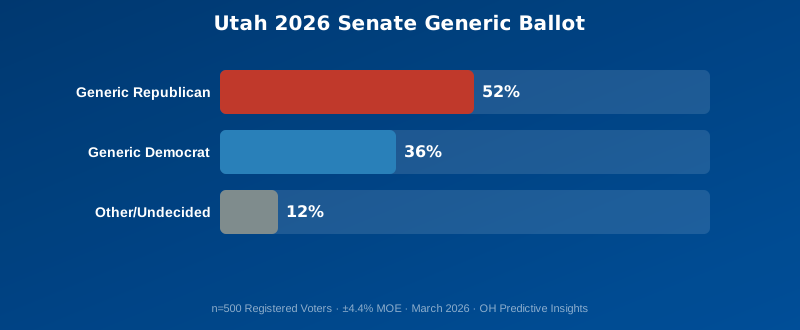
On the generic Senate ballot, Republicans lead Democrats 52% to 36%, with 12% undecided or preferring another candidate. While Republicans maintain a significant structural advantage in deep-red Utah, the 36% Democratic generic ballot number — the highest recorded by UTPOP — reflects the unique opportunity created by an open seat and a political environment in which moderate Utah voters have shown increasing willingness to cross party lines.
The GOP primary field is currently unsettled. Lt. Gov. Deidre Henderson leads with 21% support among likely Republican primary voters, followed by Congressman Blake Moore at 16% and former State AG Sean Reyes at 13%. Fifty percent of Republican primary voters are undecided, reflecting the early stage of the race.
"Mike Lee held this seat for 16 years, and his departure creates genuine uncertainty about the direction of Utah's Republican Party," says OHPI Chief of Research Mike Noble. "Henderson represents the more moderate, Mitt Romney-Cox wing of the party; Reyes is running as the Trump-aligned alternative. The primary will be a referendum on the soul of Utah Republicanism."
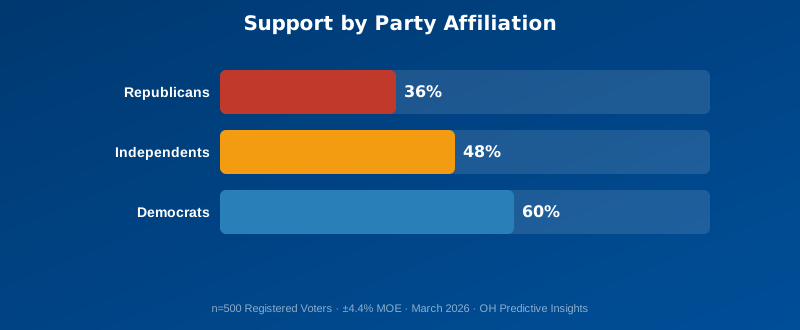
On the Democratic side, former Rep. Ben McAdams — who served one term representing a suburban Salt Lake City district — leads the Democratic primary with 34% support, followed by state Sen. Nate Blouin at 19%. McAdams represented one of the most competitive congressional districts in the Mountain West, and his electoral track record and moderate profile make him the most viable Democratic Senate candidate Utah has seen since the 1970s.
In a hypothetical general election matchup, Henderson leads McAdams 51% to 42% — a competitive race by Utah standards that reflects both the state's continuing Republican lean and McAdams' viability as a statewide candidate. Reyes leads McAdams by a wider margin, 55% to 38%, suggesting that a more Trump-aligned nominee would be less competitive in a general election against a credible Democratic challenger.
Methodology: UTPOP conducted March 14–16, 2026. n=500 Utah Registered Voters. ±4.4% MOE.
Charts & Images
Related Articles

OHPI Poll of Record: Mike Lee in Strong Position, Evan McMullin Trailing
Utah State Treasurer's Race: Marlo Oaks is Well-Positioned, 4:10 Still Undecided. OHPI UTPOP October 2022 finds Mike Lee…

UTPOP: Gov. Cox Approval at 57% — Strong Numbers as Legislative Session Closes
Utah Gov. Spencer Cox posts a robust 57% job approval rating as the 2025 legislative session concludes, with strong bipa…

UTPOP: Trump Dominates Utah GOP Presidential Primary — Leads 68% to 22%
Donald Trump leads the 2024 Utah Republican presidential primary by a commanding 46-point margin, 68% to 22% for Ron DeS…

The Curious Case of Mitt Romney
Romney enjoys favorability from a majority of Utah voters, but a plurality are against a Romney re-run, according to OHP…